
Ofek | Ecosystem : National Center for Rehabilitation, Productivity, and Leadership for the Psychologically Injured and PTSD
The Unaddressed Gap
The Iron Swords War has left tens of thousands of newly physically and psychologically injured IDF soldiers and security forces, a number expected to grow by tens of thousands more in the coming years. This is in addition to hundreds of thousands of veteran disabled IDF and security personnel (in the recent war alone, over 10,000 veterans of previous wars filed claims for PTSD recognition and injury aggravation). Existing rehabilitation pathways are fragmented across the Rehabilitation Department, health funds (Kupot Holim), non-profits, and separate professional frameworks; the focus remains on stabilizing pathology rather than restoring productivity. The result: prolonged recovery time, long-term damage to human capital and family resilience, and a loss of functional capacity in the occupational-career sphere.
The Innovation – From “Rehabilitation” to “Productivity and Leadership”
Ofek | Ecosystem is a federal model that unites five coordinated arms under one roof (**Therapy, Career, Innovation, Rights, Academia**). These arms guide the injured individual through a continuous, documented “Productive Rehabilitation Protocol” from the initial crisis stage all the way to social-entrepreneurial leadership. The therapeutic approach is based on Albert Bandura’s Self-Efficacy theories and **Post-Traumatic Growth (PTG)**: trauma is not merely a wound; it can serve as a launching pad for new productivity and leadership.
The Five Arms and Their Contribution to Rehabilitation and Productivity
* **Therapeutic Arm**
An evidence-based basket of solutions: CBT, PE, EMDR, VR therapy, agro-therapy, forest medicine, and group-family therapy. This arm leads the stabilization of the injured individual, the reduction of symptomatology, and the building of personal self-efficacy as the foundation for functional rehabilitation. It includes joint sessions with first-degree family members—husbands/wives, children, and parents—out of the understanding that the injury impacts the entire family, not just the individual.
* **Career and Employment Arm**
A gradual pathway from Day 1 encompassing training, protected productivity, temporary employment, and full placement—guided by mentors, occupational psychologists, and partner employers. The ultimate goal: restoration and long-term retention in the labor market within 12–18 months from the start of the process, including dedicated tracks for veterans requiring renewed professional “content acquisition.”
* **Innovation and Entrepreneurship Arm**
An incubator for injured entrepreneurs: guidance in venture development, access to technology, milestone-based funding, and industry partnerships. It transforms the injured individual from a service-recipient into an initiator and a creator of economic and social value, thereby strengthening the rehabilitating individual’s status within their community and family.
* **Rights and Bureaucratic Guidance Arm**
A single system that conducts professional mapping and centralizes entitlements vis-à-vis the Rehabilitation Department, the National Insurance Institute (Bituach Leumi), health funds, and authorities. Pro-bono guidance through medical committees accelerates processes, eliminates friction, and relieves the injured individual and their family from the bureaucratic burden that delays recovery.
* **Academia and Research Arm**
Documenting outcomes, developing evidence-based protocols, and training a new generation of therapists. This arm transforms Ofek into a national knowledge center for PTSD rehabilitation, providing the IDF Disabled Veterans Organization with a research-based foundation for advocacy before government ministries and the Rehabilitation Department regarding the expansion of rights and the deepening of solutions for its members.
The Customer Journey – Nine Stages
> Initial Outreach $\rightarrow$ 1. Intake and Mapping $\rightarrow$ 2. Therapeutic Stabilization $\rightarrow$ 3. Building Self-Efficacy $\rightarrow$ 4. Protected Productivity $\rightarrow$ 5. Temporary/Social Employment $\rightarrow$ 6. Full Placement / Independent Venture $\rightarrow$ 7. Maintenance and Relapse Prevention $\rightarrow$ 8. Leadership and Guidance.
Each stage is documented in a single system with clear outcome metrics (stabilization time, employment return rate, subjective well-being, economic growth pace). The guidance is continuous—there are no blind spots between the arms, and no participants are abandoned between systems.
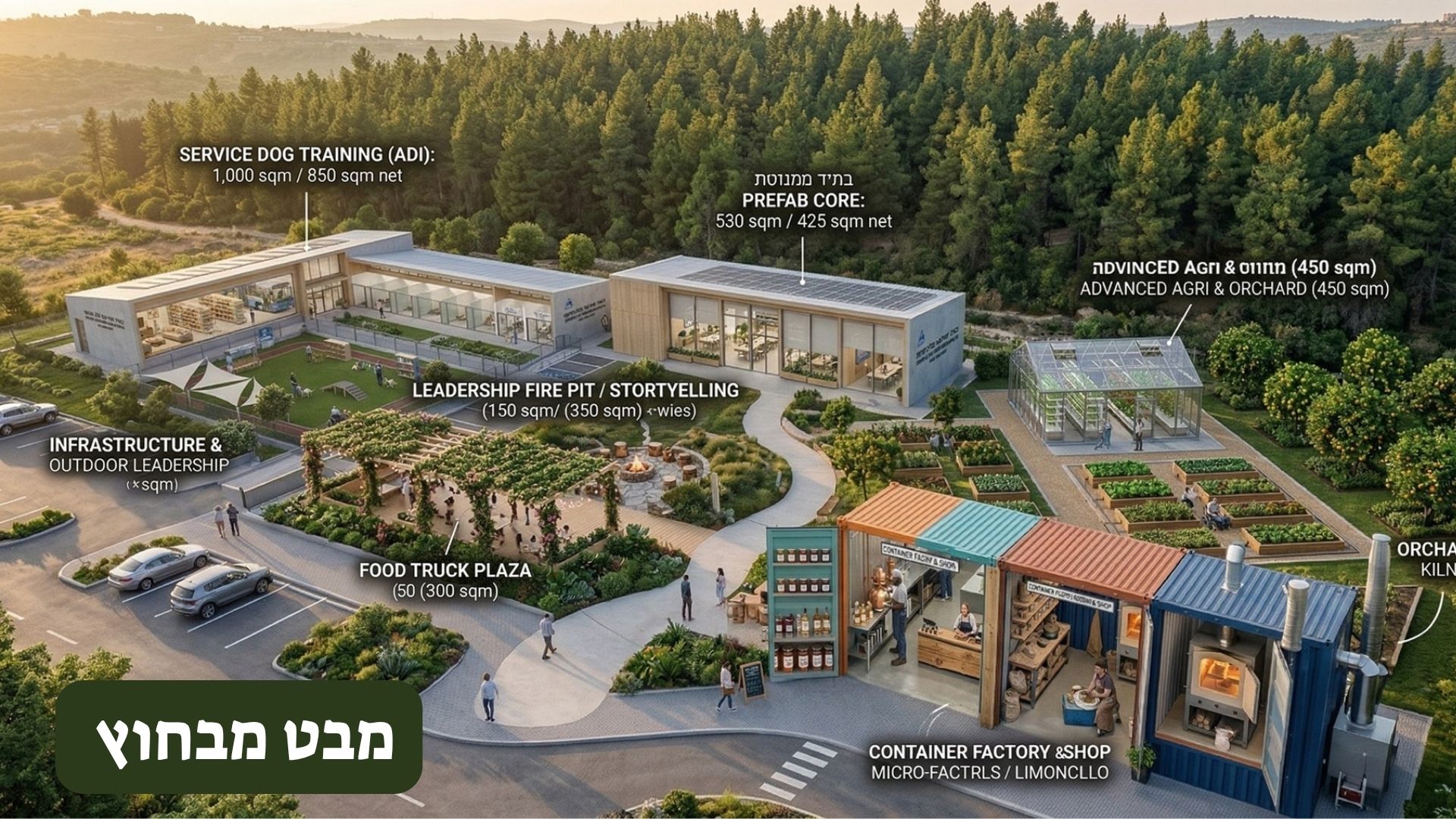
The first ecosystem hubs are currently being established in the Gederot region and the Safed (Tzfat) region, and include the following structures:
* A modular main building of approximately 400 sqm, suitable for gradual expansion based on the intake rate of participants from each program stage.
* 6 one-on-one therapy rooms, 2 VR/simulation rooms, and a family therapy room.
* A multi-purpose hall for group therapy, workshops, community events, and lectures.
* A protected productivity complex featuring a workshop, training rooms, and mentor-mentee spaces.
* A therapeutic yard for agro-therapy, medical gardening, natural spaces, and practice.
* Management offices and rooms for the multi-disciplinary team.
The Clinical Model
1. The Theoretical Framework: Bandura’s Self-Efficacy Model
At the core of Ofek’s operations lies the Social Cognitive Theory of Prof. Albert Bandura, which defines the concept of **Self-Efficacy**—an individual’s belief in their ability to mobilize the cognitive and motivational resources required to successfully execute a task. Among trauma-injured combatants, this belief is severely shattered. The therapeutic system at Ofek repairs this fracture using the four sources of information identified by Bandura:
1. **Performance Accomplishments (Mastery Experiences):** The most powerful source. At Ofek, the combatant does not merely “talk” about difficulty but experiences operational success—ranging from growing agricultural produce in a greenhouse to debugging AI systems. This tangible success dismantles the sense of helplessness.
2. **Vicarious Experiences (Social Modeling):** Being present within the ecosystem exposes the participant to peers who are in advanced stages of rehabilitation. Observing another combatant leading a technological project or managing the factory store reinforces the belief that “I can do it too.”
3. **Social Persuasion:** The professional staff and business mentors act as “efficacy agents.” They provide constructive, precise feedback on performance, encouraging the participant to persevere and invest effort even when facing obstacles.
4. **Physiological and Emotional States Regulation:** Trauma distorts the body’s interpretation of stress. Through forest medicine, yoga, and regulation technologies, the participant learns to identify bodily tension not as a “danger” but as a temporary, manageable state, enabling them to function under pressure within the productive space.
2. The Gateway: Multi-Dimensional Intake and Building a Personal Growth Plan
To translate the theoretical model into functional reality, every participant undergoes a holistic intake process that serves as the launching pad for shifting the narrative:
* **Asset Mapping:** In contrast to traditional diagnostics that focus on impairment, intake at Ofek focuses on mapping skills, professional inclinations, and leadership aspirations alongside the clinical diagnosis.
* **Tailored Plan Construction:** A multi-disciplinary team builds a plan together with the participant, combining customized dosages of clinical therapy, technological exposure, and productive work. The plan defines personal key performance indicators (KPIs) that allow the combatant to experience **Quick Wins**.
* **Partnership Agreement:** The participant signs an “Efficacy Contract” in which they take active responsibility for their rehabilitation process. They are not a “patient” receiving a service, but a “partner” in building their own future and the future of the farm.
3. Operational Innovation: Technology in the Service of Rehabilitation
Ofek integrates cutting-edge technological tools at the therapeutic frontline to accelerate the rehabilitation and regulation process:
* **Virtual Reality Exposure Therapy (VRET):** Utilizing VR systems that simulate real-life and high-stress scenarios within a controlled environment. This technology allows for gradual exposure that numbs anxiety intensity and significantly shortens stabilization time.
* **Neurofeedback and Biofeedback Training:** Utilizing sensors to measure brainwaves and stress metrics in real time. This technology grants the participant voluntary control over their nervous system, preparing them for integration into the demanding world of employment.
4. Research Data and Economic Impact
Current research in the field of PTSD and occupational rehabilitation indicates clear trends:
* **Preventing “Acquired Disability”:** Early integration into meaningful action substantially reduces the development of depressive and dependent patterns.
* **Long-Term Stability:** Rehabilitation that integrates community and productivity has been proven more effective in preventing relapse compared to isolated clinical treatment.
* **National ROI:** Every combatant who returns to the productive cycle represents an estimated savings of millions of NIS in direct and indirect costs to the national economy over their lifetime.
5. Applied Core Values
* **Ownership & Agency:** The participant transitions from the status of “supported” to the status of “leader.” Responsibility for the output is the primary healing tool.
* **Social Integration:** The ecosystem replicates the military “squad” sentiment and converts it into a productive-civilian team.
* **Holistic Excellence:** There is no separation between body, mind, and profession. Professional excellence rests upon psychological resilience.
6. Conclusion: From Vision to Reality
The therapeutic arm at Ofek sets a new standard for combatant rehabilitation in the 21st century. The informed integration of a precise intake process, established psychological theories, and a unique productivity model creates a clear, sustainable path for IDF combatants.
By building a space where trauma is translated into creation and leadership, we ensure that the State of Israel’s most precious human resource will continue to lead, contribute, and thrive.
“Building self-efficacy is not just a therapeutic goal; it is a national mandate.”
Ofek Ecosystem’s “Golden Team”
**Includes one hundred retirees from the top tiers of the business sector serving as mentors for the injured.**
The “Golden Team” mentors serve as professional and personal anchors while mobilizing community and municipal resources:
* **Occupational Rehabilitation Case Management:** Mapping barriers, building a personal work plan, and guiding the injured individual from the ideation stage to job integration.
* **Opening Doors and Networking:** Utilizing personal connections, linking to employers in the municipal and national spheres, and initiating employment opportunities.
* **Mental-Occupational Mentoring:** Ongoing support during moments of crisis, assisting in building occupational resilience, and reinforcing the sense of self-efficacy.
* **Bureaucratic Mediation:** Assisting in dealings with institutional bodies, rehabilitation centers, and the local authority to maximize rights and create a holistic envelope.
The Social Bottom Line
Beyond impressive economic profitability, Ofek Ecosystem generates consistent national savings by reducing chronic disability percentages and returning combatants to the circle of productivity and taxation.
7. National ROI
**Turning a “Budgetary Burden” into a “Productive Asset.”**
* **Reduction of Allowances:** The cost of a chronically injured PTSD veteran to the state is estimated at 5 to 10 million NIS over their lifetime (allowances, housing, mobility, treatments). Every injured individual we return to the workforce saves the state the majority of this sum.
* **GDP Growth:** Combatants and reservists constitute the highest quality workforce in the economy. Returning them to productivity translates to tax payments (income tax, VAT, national insurance) instead of allowance consumption.
* **Preventing “Acquired Disability”:** Parallel intervention (therapy + work) prevents deterioration into the state of a “professional disabled person” who loses capability as time passes without employment.